
Loading search results…
Loading products…
Planning · October 2026
Pickup day is 100 to 125 lb of frozen beef and a 2-hour clock. Here is how many coolers to bring, what to do the night before, and how to get it all into the freezer at 0°F.
You reserved the quarter. You paid the deposit. You filled out the cut sheet.
Now the farm texts you: “Your beef is ready. Pickup Saturday 9 to noon.”
Cool. Now what?
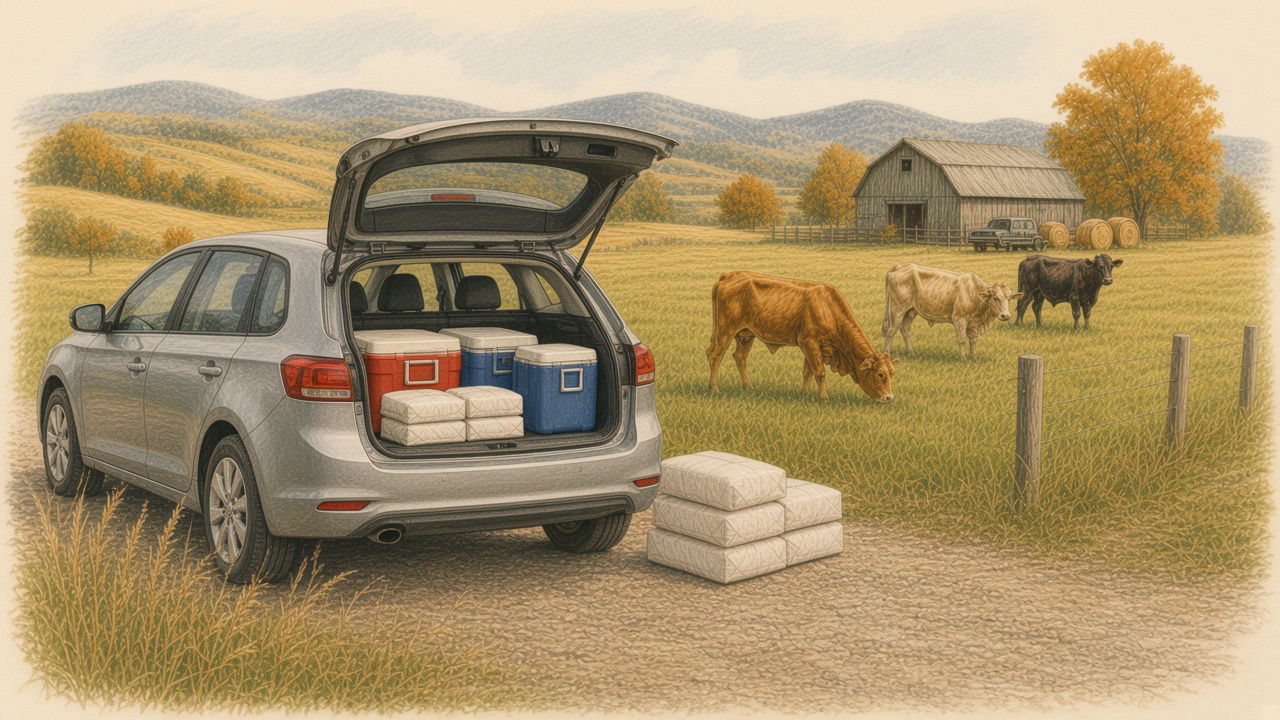
Most people show up with one cooler and a hatchback full of groceries. Then they stand in a gravel lot playing Tetris with 40 white packages of ground beef.
Don't be that guy. Pickup is easy if you plan for three numbers.
100 to 125 lb. That's the usual take-home on a quarter cow (see how much meat is in a quarter cow). That's not a grocery run. That's a car trunk.
5 to 7 cubic feet. That's how much freezer space a quarter needs (see how much freezer space for a quarter cow). It's also how much cooler space you need for the drive home.
2 hours. USDA's rule: perishable food shouldn't sit above 40°F for more than 2 hours, or 1 hour when it's over 90°F outside. Frozen beef won't warm up that fast in a closed cooler. But that's the clock you're playing against.
Everything else is logistics.
Clear the freezer. Make sure you actually have 5 to 7 cubic feet open. Your kitchen fridge freezer probably won't cut it. A quarter is a chest freezer job (see what size chest freezer for a quarter cow).
Check the temp. USDA says keep a freezer at 0°F or below for long-term storage. Toss an appliance thermometer in there. They cost a few bucks. If the freezer is brand new, plug it in at least a day early so it's cold when the beef shows up.
Freeze some ice. Fill a few gallon jugs or bags. You'll use them to fill gaps in the coolers.
Confirm the details. Ask the farm or butcher three things:
That last one matters. Boxes are easy to stack. Loose packages need coolers.
| Item | How much | Why |
|---|---|---|
| Large coolers | 3 to 4 | 5 to 7 cu ft is about 150 to 210 quarts of space |
| Frozen jugs or ice bags | A few per cooler | Fills the gaps so air doesn't warm things |
| Moving blankets or old towels | 2 or 3 | Insulation on top of coolers or boxes |
| Your cut sheet | 1 copy | So you can check what you got |
| Payment for the balance | Whatever's due | Most farms collect the rest at pickup |
The cooler math is simple. One cubic foot is about 30 quarts. A quarter needs 5 to 7 cubic feet. So you want roughly 150 to 210 quarts of cooler. That's three or four of the big ones.
Don't own that many? Borrow. Or bring sturdy cardboard boxes and pack them tight with blankets on top. Frozen beef packed together keeps itself cold. A cooler packed tight beats a big cooler with air in it.
Count before you load. Pull out your cut sheet. Did you ask for the brisket whole? Are the roasts there? Did the soup bones make it? It's way easier to fix at the counter than three days later over text.
Check that it's frozen solid. It should be rock hard. If anything feels soft, say so right there.
Pack tight, heaviest on the bottom. Roasts and ground on the bottom. Steaks on top so they don't get crushed. Fill every gap with ice jugs or towels.
Lids closed. Go straight home. This isn't the day to also hit Target, grab lunch, and swing by your mom's.
Keep the coolers in the air-conditioned car, not baking in an open truck bed in July. On a cool day, the trunk is fine.
Most pickups are well under an hour from home. That's no problem. Frozen beef in a full, closed cooler stays frozen a lot longer than the drive takes.
Live far away? Bring more ice, and don't open the lids until you get home.
You're home. Now move fast.
Unload one cooler at a time. Keep the others closed.
Organize as you go. Ground beef in one zone. Steaks in another. Roasts on the bottom. You'll thank yourself in February when you're looking for the one chuck roast.
Oldest on top later. When you add next year's beef, the new stuff goes underneath.
Check the thermometer the next morning. A freezer stuffed with 100+ lb of beef should settle back to 0°F. A full freezer is actually a good thing. USDA says a full freezer holds its temp about 2 days if the power goes out. A half-full one only lasts about 1 day.
Relax. USDA says if food still has ice crystals, or is still as cold as a fridge (40°F or below), it's safe to refreeze. You might lose a little quality from the moisture. Not safety.
What you don't want: anything that sat above 40°F for more than 2 hours. That doesn't go back in.
Once it's in at 0°F, USDA says frozen food stays safe indefinitely. The time limits are about quality:
| Cut | Best quality at 0°F |
|---|---|
| Steaks | 4 to 12 months |
| Roasts | 4 to 12 months |
| Ground beef | 3 to 4 months |
Ground beef is most of your quarter, so eat that first. Vacuum-sealed beef usually holds quality longer (see how long does vacuum-sealed beef last).
Some people don't want the gravel lot, the coolers, or the 9 to noon window.
Fair.
Our eighth cow starter share is about 50 lb of 100% grass-fed beef, $749 all-in with shipping. It shows up at your door, frozen. No coolers. No pickup window. And it fits in a smaller freezer.
Buy the eighth cow share →Don't open 14 tabs.
The $4.99 freezer report is a ranked shortlist of quarter, half, and whole cow options near you. One page. Farms ranked.
Get the Freezer Report →Monthly Access is $6.99/month. Unlocks the full catalog of farm beef near you. Every quarter, half, and whole cow you can reserve.
Start smaller with the eighth, get a ranked farm shortlist, or open the full local catalog.
$4.99 ranked shortlist of quarter, half, and whole farms near you.
Get the Freezer Report →