
Loading search results…
Loading products…
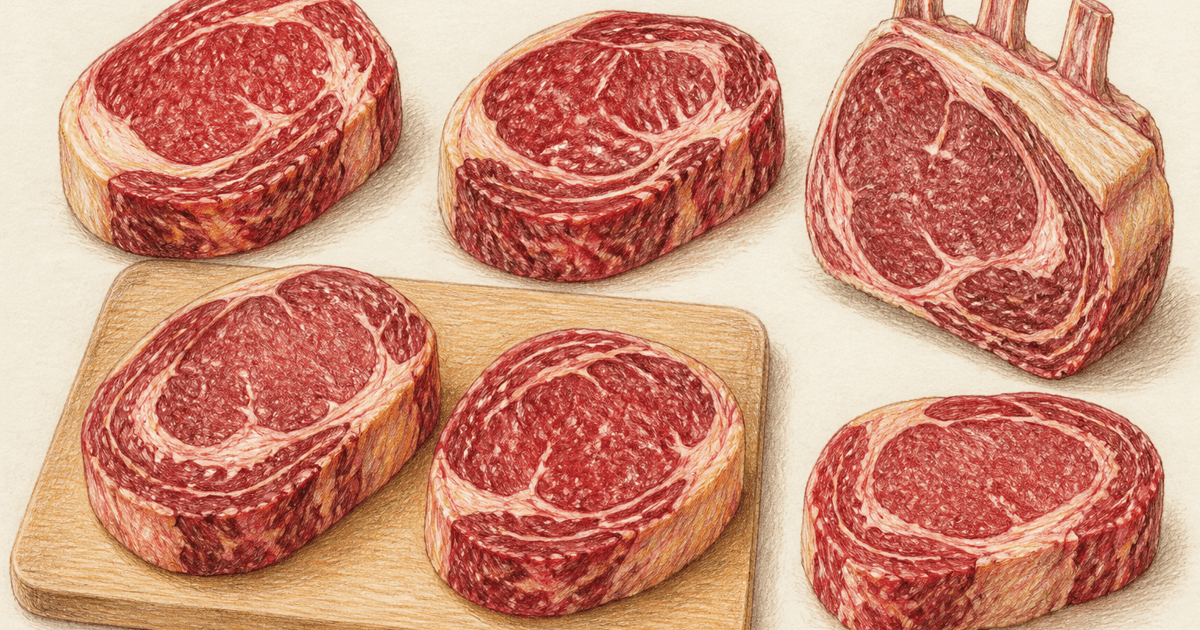
Getting started · September 2026
About 4–6 packages — usually 8–12 steaks at 1 inch. Here's the rib primal split, why thickness changes the count, and what bone-in vs boneless really means for your freezer.
People don't buy a quarter cow for the stew meat.
They buy it for the ribeyes.
The grocery-store ribeye is the cut that makes you pause in the meat case, check the price, put it back, then put it in the cart anyway. On a beef share, that same cut shows up as a stack of packages — and the question is always the same: how many?
Short answer: about 4–6 packages, which is usually 8–12 individual ribeyes if you cut them at 1 inch with two steaks per pack. That's 5–8 lb of ribeye from a standard quarter cut sheet.
Not a mountain. Not a joke either. Enough for months of Saturday nights.
A standard quarter cow cut sheet produces about 4–6 ribeye packages (roughly 8–12 steaks at 1" thickness). The rib primal on your quarter is finite. Two things move the package count:
On a default locker sheet at 1–1.25", most people land in the 4–6 package / 8–12 steak range.
A steer has one rib primal on each side. A quarter is one side. Your ribeyes come from that side's rib section (typically ribs ~6–12).
That section becomes ribeye steaks, OR a standing rib roast / prime rib if left whole, OR a mix. You do not get unlimited ribeyes — you get one rib section. How the butcher slices it decides 12 thin steaks vs 6 thick ones.
Thickness and bone-in vs boneless change how many packages you stack. The primal weight stays in the same 5–8 lb range.
| Cut style | Packages | Individual steaks | Approx. lb | Notes |
|---|---|---|---|---|
| Ribeye @ 1" (2/pkg) | 4–6 | 8–12 | 5–8 lb | Default at most lockers |
| Ribeye @ 1.25" | 4–5 | 7–10 | 5–8 lb | Common compromise |
| Ribeye @ 1.5" | 3–4 | 5–8 | 5–8 lb | Restaurant-style thick |
| Bone-in ribeye | 3–5 | 6–10 | 6–9 lb | Heavier packages; bone in the weight |
| Boneless ribeye | 4–6 | 8–12 | 5–8 lb | More edible meat per lb labeled |
Same ~5–8 lb of ribeye meat either way. Thickness and bone change the package count — not magic extra beef.
Our eighth cow starter share is about 50 lb, 100% grass-fed, $749 all-in with shipping. Fixed cut mix. Ribeyes included.
Buy the eighth cow share →A rib section yielding about 6 lb of steak meat cuts into roughly 8 steaks at 1" or about 5 steaks at 1.5". Same beef. Different Saturday nights.
Write thickness on the cut sheet. Lockers default to 1–1.25" if you leave it blank.
Bone-in looks impressive and tastes great next to the bone. Packages weigh more because bone is in the labeled weight. Boneless puts more pure steak in the freezer per pound on the label.
Neither is “more ribeyes.” Boneless often means slightly more steak packages after the bone is removed. Bone-in means fewer, heavier packs.
Not most of the box.
Out of 100–125 lb take-home:
At $800–$1,200 all-in, you're paying roughly $6–$10/lb across everything, including ribeyes that run $18–$30/lb at grocery.
Want the full steak count, not just ribeyes? How many steaks in a quarter cow. For the whole-box weight split, see how much meat is in a quarter cow.
Say you get 10 ribeye steaks (5 two-packs). Family of four. One ribeye night a month.
That's 5 months of dedicated ribeye nights — before strips, filets, or ground. The splurge is already in the freezer.
The Freezer Report is a $4.99 ranked shortlist of quarter, half, and whole cow options in your area.
Get the Freezer Report →More on filling the form in how to read a cut sheet, what is hanging weight, and how many steaks in a quarter cow.
$6.99/month unlocks the full catalog of farm beef options near you.