
Loading search results…
Loading products…
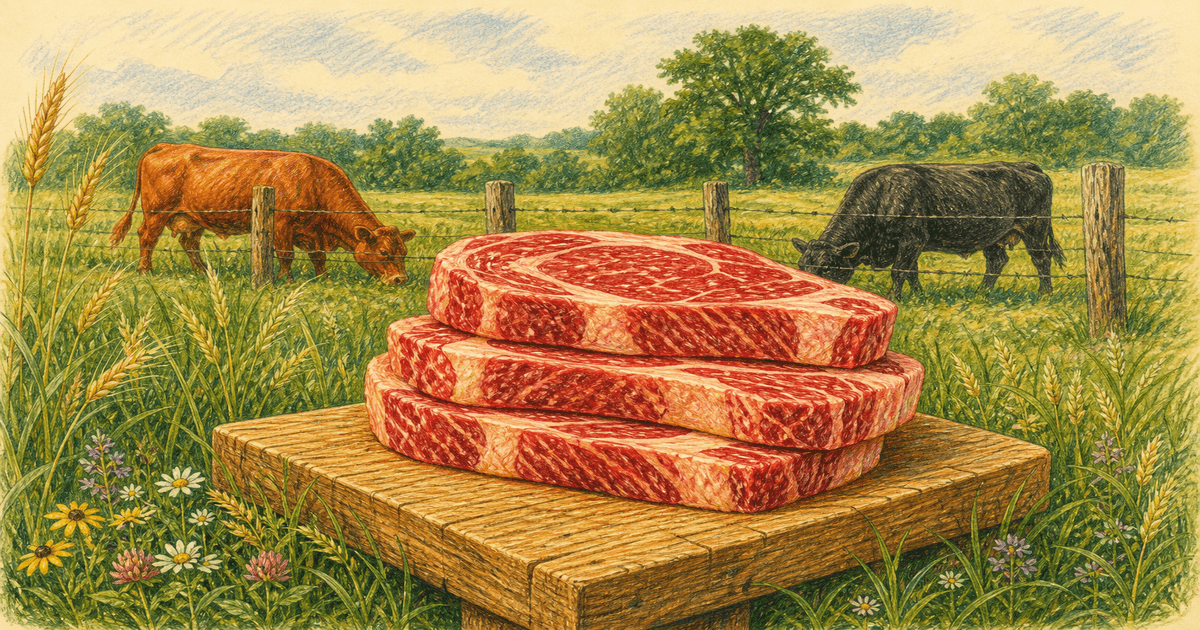
Getting started · September 2026
About 15–25, depending on your cut sheet and how thick you run them. Here's the real package count, why thickness moves the number more than anything else, and what steak night actually looks like for a family of four.
People buy a quarter cow for the steaks.
They talk about the ground beef savings. They do the math on roasts. But the real reason they sign up is the vision: a freezer stacked with ribeyes, strips, and tenderloins they didn't have to pick off a grocery shelf one at a time.
Then the boxes arrive. And somebody always asks: “Wait — that's it?”
Steaks are not most of a quarter cow by weight. They're probably 15–20 lb out of 100–125 lb take-home. The rest is ground beef, roasts, short ribs, stew meat. The steaks are the minority.
But that minority can still be 20 packages. Here's exactly what you get.
A standard quarter cow cut sheet produces about 15–25 steaks in individual or two-pack packages. The spread is wide because two things move the number dramatically:
On a default cut sheet at standard thickness (1–1.25 inches), most people end up in the 18–22 package range.
These are the five cuts most butchers pull as individual steaks on a standard cut sheet. Package counts assume 1-inch thickness and two steaks per package on most cuts.
| Cut | Packages | Approx. lb | Notes |
|---|---|---|---|
| Ribeye | 4–6 | 5–8 lb | 2 steaks/pkg at 1"; request 1” for more packages |
| NY Strip (strip loin) | 4–6 | 4–7 lb | Same primal as T-bone; butcher decides the split |
| Filet / Tenderloin | 2–3 | 2–4 lb | Small muscle; a quarter has one small tenderloin |
| T-Bone | 2–3 | 3–5 lb | Strip + small tenderloin; bone-in; some lockers skip this section |
| Porterhouse | 1–2 | 2–4 lb | Larger tenderloin section than T-bone; overlaps with strip yield |
| Premium total | 13–20 pkg | ~15–20 lb | Depends on loin split and thickness |
Note: T-bone, porterhouse, and NY strip all come from the same short loin. Most butchers will do one or two of these, not all three from a single quarter. The split is part of what your cut sheet controls.
The short loin and rib primals get the headlines, but a quarter cow also yields a handful of secondary steaks that most grocery stores either don't carry or charge a premium for.
1–2 packages. Thin, wide, and built for marinating. One of the best cuts from a grass-fed steer.
1–2 packages. Thin diaphragm muscle. Intense flavor. Often goes to grind if not requested explicitly.
2–4 packages depending on cut sheet. Leaner cuts from the hindquarter; great for cubing or slow braises.
Add these specialty steaks to the premium count and you can comfortably reach the top of the 20–25 package range. Whether these show up in your box depends almost entirely on how you fill out the cut sheet.
Want to know exactly how to fill one out? Our cut sheet guide walks through every line item.
Our eighth cow starter share is about 50 lb, 100% grass-fed, $749 all-in with shipping. Fixed cut mix. No locker math. Steaks included.
Buy the eighth cow share →This is the thing most people don't realize until they've done it twice.
A ribeye primal on a quarter cow has roughly the same amount of meat whether you cut it into 8 thin steaks or 4 thick ones. More packages does not mean more beef. It means thinner steaks.
Quick math: cutting at 1” vs 1.5”
A ribeye section yielding 6 lb of steak meat cuts into roughly 8 steaks at 1” or about 5 steaks at 1.5”. Same pound of beef. Very different freezer experience.
Most lockers default to 1–1.25 inches if you don't specify. If you want thick-cut restaurant-style steaks, write 1.5” on the cut sheet. If you want more packages and faster weeknight cooks, write 1”.
This is the part people don't love hearing.
Out of 100–125 lb take-home, the premium steak cuts represent roughly 15–20 lb. Add in specialty steaks and you're closer to 20–25 lb. That's about 15–20% of your total box.
The good news: ground beef from a grass-fed quarter cow is not a consolation prize. It's a completely different product from grocery ground. The steak packages are still why people buy. But the ground is what makes the economics work.
More detail on the full weight breakdown in our quarter cow meat breakdown.
Let's say you end up with 20 steak packages. Family of four. You do steak night twice a month.
That's 10 months of steak nights from a single quarter. You won't run out. The ribeyes and strips won't run out. The problem isn't volume — it's novelty. You rotate the cuts and suddenly every steak night feels intentional instead of “what's on sale at the store.”
Sample quarter cow steak rotation (20 packages)
That's before the ground beef and roasts. At $800–$1,200 all-in for the whole quarter, you're paying roughly $6–$10/lb across all cuts — including the ribeyes.
The Freezer Report is a $4.99 ranked shortlist of quarter, half, and whole cow options in your area. One page. No farm directory rabbit holes.
Get the Freezer Report →None of the numbers above are fixed. They're defaults.
A cut sheet is the form you fill out to tell the butcher what to do with your half of the beef. You choose steak thickness. You choose whether the chuck becomes roasts or gets ground. You choose whether the sirloin tip becomes steaks or stew meat.
If you optimize for steaks, you can push toward the high end of that 25-package number. If you don't fill it out at all, the locker makes decisions for you — and they're not wrong, just generic.
Read the full breakdown in our cut sheet guide and what is hanging weight before you place your order.
$6.99/month unlocks the full catalog of farm beef options near you — every quarter, half, and whole cow available in your area.