
Loading search results…
Loading products…
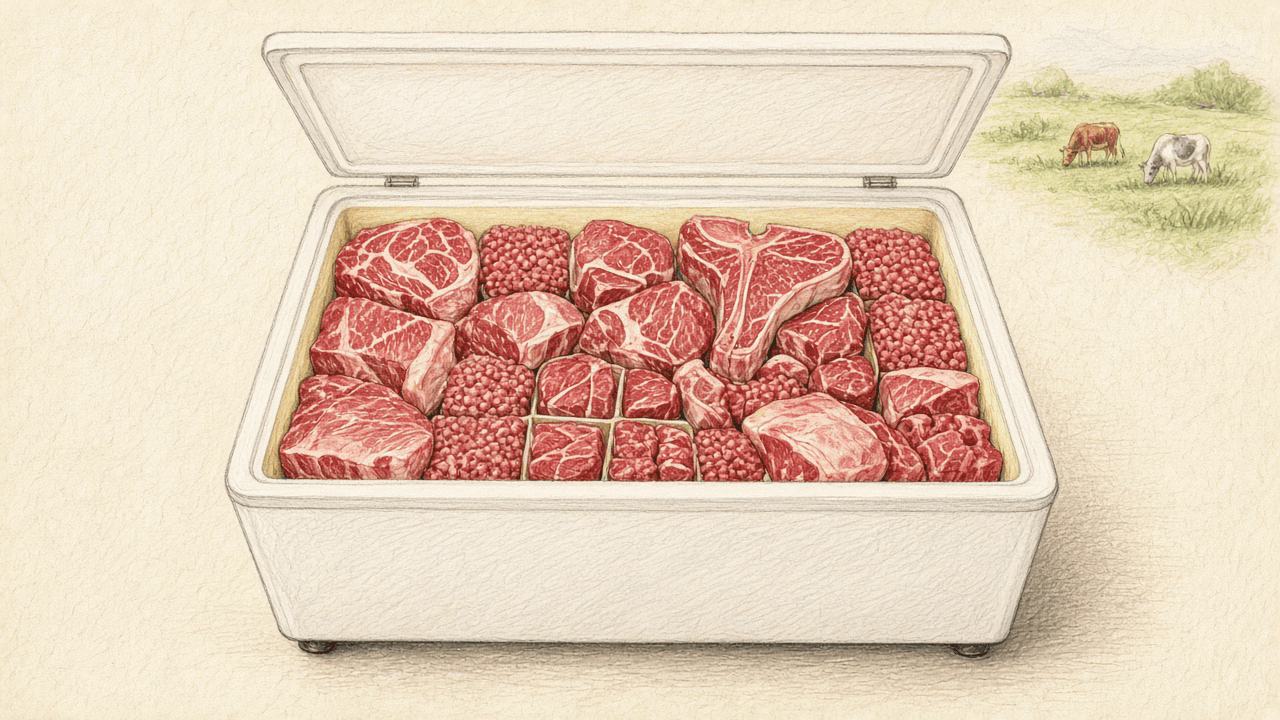
Planning · September 2026
A half cow is about 200–250 lb of take-home. That usually wants a 9–15 cu ft chest freezer. Here is the store-shelf size chart, not the abstract cube math.
A half cow usually wants about a 9–15 cu ft chest freezer.
Not the fridge freezer. Not a 5-foot garage leftover. A real dedicated box in the size range you actually see on the shelf.
You already know the space math from how much freezer space for a half cow: about 8–10 cubic feet for 200–250 lb. This post is the next question. Which sticker size do you buy when you are standing in the aisle?
Half take-home: 200–250 lb.
Space you need: about 8–10 cubic feet of dedicated empty freezer.
Appliance you buy: usually a 9–10 cu ft chest if it is empty and only for the beef. Often smarter: a 12–15 cu ft chest if you want bins, labels, and a little room for household frozen food.
| Share | Take-home | Space needed | Chest size to buy |
|---|---|---|---|
| Eighth | ~50 lb | ~2–3 cu ft | Fridge freezer can work (eighth freezer space) |
| Quarter | 100–125 lb | 5–7 cu ft | 5–7 cu ft chest (quarter freezer space) |
| Half | 200–250 lb | 8–10 cu ft | 9–15 cu ft chest |
| Whole | 400–500 lb | 15–20 cu ft | 15–20+ cu ft (whole freezer space) |
Half cow overview lives on half cow shares.
Retail chests cluster in familiar bands. Think in these buckets, not brand mythology.
| Sticker size | Can it hold a half? | Honest take |
|---|---|---|
| 5 cu ft | No | Quarter territory. A half will overflow. |
| 7 cu ft | Usually no | Tight even empty. Fine for a quarter. Risky for 200–250 lb. |
| 9–10 cu ft | Yes, if dedicated | The usual half-cow buy. Empty. Vacuum packs. Packed tight. |
| 12–15 cu ft | Yes, with air left | Buy-one-size-up. Room for baskets and a turkey. |
| 20+ cu ft | Yes, with lots left | Whole-cow / multi-animal volume. Overkill for one half alone. |
The sticker is empty volume. If the 10 cu ft box still has a lasagna and two bags of fries, you do not have 10 cu ft.
Big-box floors commonly stock ~7, ~9–10.5, ~12–15, and ~20 cu ft chests. Exact model numbers change. The band matters more than the badge.
Math says ~8–10 cu ft. Life says you will dig for a ribeye at 6 pm on a Tuesday.
Extra cubes buy:
If money is tight and the freezer is truly dedicated, a clean 9–10 cu ft chest works. If you can stretch, land in 12–15. That is the “I will still like this next year” buy.
Chest wins on density and power-outage hold. Cold air sits. Flat vacuum packs stack.
Upright wins on “where is the sirloin.” Shelves waste cubes. Door racks waste more. If you go upright for a half, size up into the 13–15 cu ft range to match what a 10 cu ft chest actually holds.
For most half-cow buyers, the boring correct answer is still a chest in the 9–15 cu ft band.
Garage or unheated basement? Prefer a garage-ready model in that same size band. Standard freezers can sulk in a cold garage.
Same 225 pounds. Different pile.
Ask for vacuum seal before pickup. Then buy the freezer size for the pack style you actually ordered.
This is the failure mode. The farm texts. The boxes are ready. You have a Civic and a fridge that already lost to frozen waffles.
Meat does not wait in the driveway.
Do this the week you put the deposit down:
More layout detail lives in how to store a quarter or half cow.
Our eighth cow starter share is about 50 lb, 100% grass-fed, $749 all-in with shipping. Fixed cut mix. About 2–3 cu ft. Fits a lot more kitchens than a half.
Buy the eighth cow share →Still comparing farm vs grocery stretch? See eighth cow vs a month of grocery beef.
The Freezer Report is a $4.99 ranked shortlist of quarter, half, and whole cow options in your area. One page. Farms ranked. Not a concierge call.
Get the Freezer Report →$6.99/month unlocks the full catalog of farm beef options near you. Every quarter, half, and whole cow available in your area.